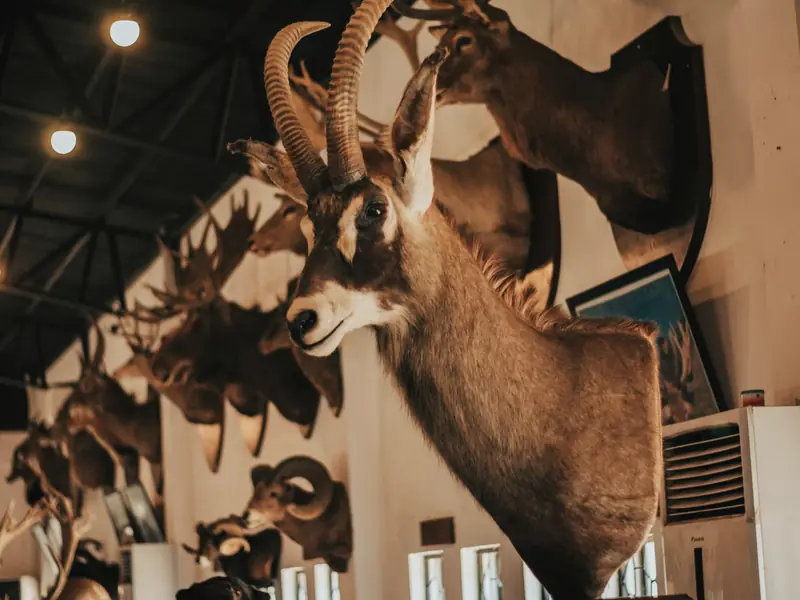
An educational profile of the markhor, a wild mountain goat famous for its spiral horns. Hunting and nature museums often display mountain bovids; this profile does not state that the museum holds a markhor specimen.
Physical Description of the Markhor
The markhor (Capra falconeri) is one of the largest wild goats in the world. Males are clearly bigger than females and carry a long beard and a mane of hair on the neck and chest. The coat is greyish brown, paler and longer in winter. Females are smaller, with a slightly redder coat and short, thin horns.
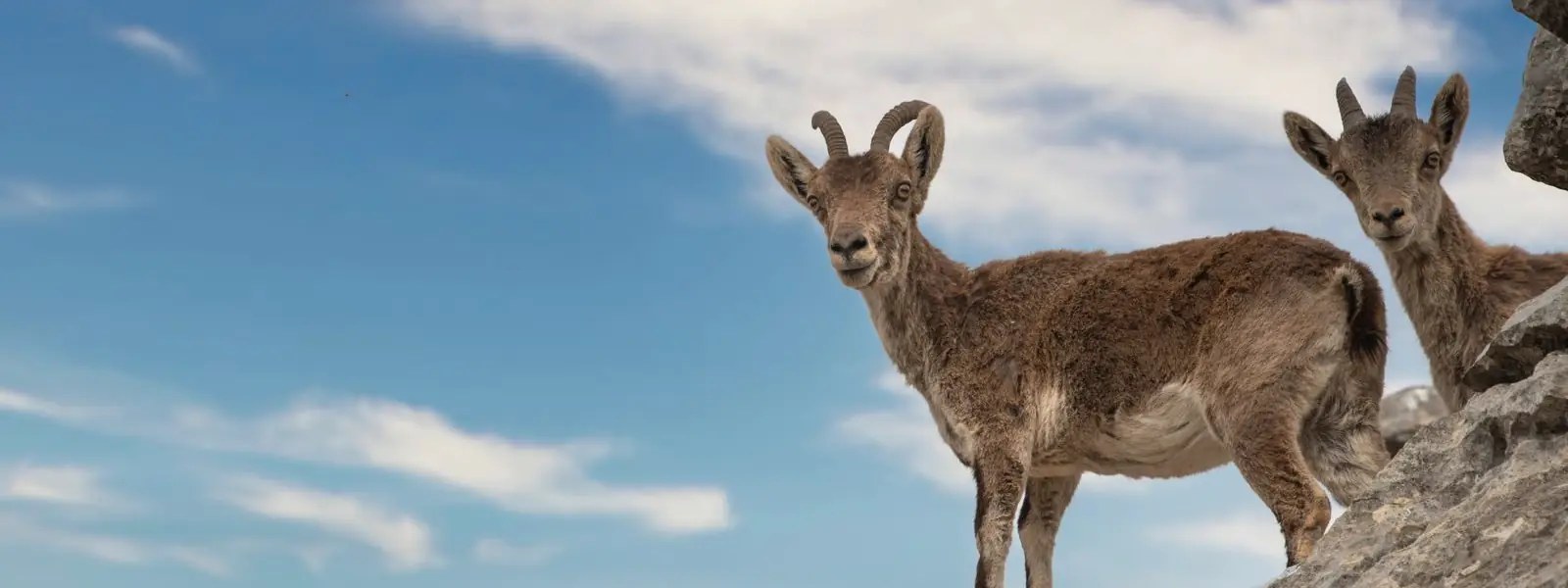
What stands out most are the males' horns: spiral, twisted around themselves like a corkscrew, and able to exceed a metre in length in adult animals. Their exact shape varies among the described subspecies.
Habitat and Geographic Distribution
It lives in the mountains of central and southern Asia: Afghanistan, Pakistan, northern India, Tajikistan, Uzbekistan and Turkmenistan. It occupies steep, rocky slopes with scrub and open pine and oak woods, from a few hundred metres to more than three thousand metres of altitude, and moves with the seasons.
Behavior and Social Structure
Females form small groups with their young and juvenile males. Adult males live alone or in male groups outside the rut, which takes place in winter. Kids are born in spring, usually one or two per female. Markhors graze and browse, relying more on leaves and twigs in winter.
Conservation Status and Threats
The IUCN Red List classed it as Endangered for years and, since the 2015 assessment, lists it as Near Threatened, an improvement due in part to protection programmes. It is in CITES Appendix I, which bans international commercial trade. The threats are illegal hunting, habitat loss and competition with domestic livestock.
In Pakistan there are community programmes that allow regulated hunting of a few older males, with income going to local communities and patrols against poaching. Their results are debated, but they are often cited as an example of community-based management.
Ecological Importance of the Markhor
As a mountain herbivore, the markhor influences slope vegetation and serves as prey for predators such as the snow leopard and the wolf. Its presence points to healthy pastures and slopes, and its decline often signals wider problems in the ecosystem.
The Markhor in Culture and Mythology
It is the national animal of Pakistan. According to a popular explanation, its name comes from Persian "mar", snake, and "khor", eater, hence "snake-eater", and local stories tell of its supposed ability to kill snakes. The etymology is disputed, and these tales belong to folklore rather than zoology.
Curiosities About Its Spiral Horns
The horns are never shed: they grow throughout life, and the rings formed each year make it possible to estimate an animal's age. Females have much shorter horns. Specialists distinguish several horn shapes by subspecies, from tight spirals to open, elongated horns.
Anyone looking for more in Spanish will find the same animal under Markhor: el animal de cuernos en espiral, with the species name Capra falconeri in both versions. The Spanish version is written independently, not as a translation of this one.
Frequently asked questions
Why does the markhor have spiral horns?
Spiral horns are a trait of the species, above all of males, who use them in rutting contests and as a sign of age and strength. The exact shape varies among subspecies.
Where does the markhor live?
In the mountains of central and southern Asia: Afghanistan, Pakistan, northern India, Tajikistan, Uzbekistan and Turkmenistan.
Is the markhor endangered?
It was listed as Endangered by the IUCN and since 2015 is listed as Near Threatened. It remains protected by CITES and its conservation depends on tackling illegal hunting.
Worth keeping in mind
IUCN categories are reviewed regularly; for the current status of the species, consult the Red List in force.